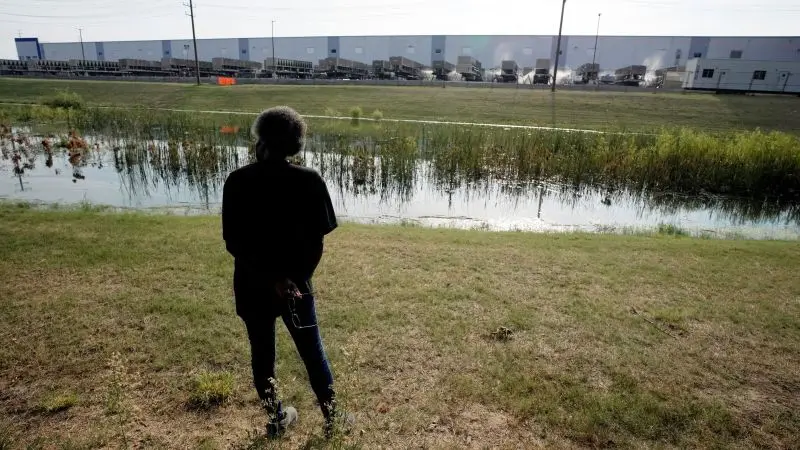
 Loretta Thornton, 66, looks at a massive artificial intelligence data center behind her home on Scaife Road on August 19 in Memphis. Colossus 2 is owned by SpaceXAI in the Whitehaven neighborhood.
Memphis leaders rejected a contentious 18-month pause on new data center development in the city Tuesday, just two weeks after a meeting on the issue led to protests, calls to police and a fist fight at City Hall.
The directive would have placed a temporary pause on new data centers and on the expansion of existing ones, as well as develop a study committee to establish regulations. Local activists, lawmakers and residents have long protested the extensive infrastructure built to feed the power-hungry artificial intelligence industry.
The 18-month moratorium vote — which was originally slated to last 12 months before it was amended earlier this month — failed in a 6-6 tie on Tuesday. The vote came more than two years after some communities in Memphis got a new life courtesy of trillionaire Elon Musk, as his artificial intelligence company moved in amid a local effort to make the city a hotspot for advanced technology. But the effort ended up angering residents as the company installed dozens of gas-powered turbines, known to produce a cocktail of toxic pollutants.
“I think we failed the citizens of Memphis tonight and what they have been asking for, so it’s really disappointing,” Council Member Jerri Green told CNN. “We had hundreds of people packed in there that waited for hours. This is the third reading. They’ve been pushing for this for over a year, they’re the people who are being deeply impacted by these environmental hazards.”
A surge of new data center construction to fuel the booming AI industry is escalating public resentment and fear of both the energy-sucking infrastructure and AI itself in the US, roiling communities from coast to coast and transforming localized energy debates into a high-stakes, multi-million-dollar battleground for the 2026 midterm elections.
At an early October council meeting in Memphis — a city used to fighting for clean air as the home to more than a dozen polluting facilities — fierce opposition was on full display. More than 100 people filed into the chamber to hear about the moratorium, bearing witness to clashes between anti-data center protesters and council members, and between the city officials themselves. Two women were also restrained in the lobby as they swung fists at each other.
“We’re not saying no to data centers forever; we’re saying slow it down so that we can make the necessary adjustments so that we can protect neighborhoods and property value, so we can make sure there’s not a detrimental impact on the environment,” Memphis City Council Member JB Smiley Jr., sponsor of the moratorium, told anchor Brianna Keilar on CNN News Central on Tuesday ahead of the City Hall meeting. “We have to make sure we’re putting people before profits.”
Before the event, Smiley said he expected 400 to 500 people to show up at City Hall on Tuesday to demand a data center moratorium.
Here’s what we know:
How Memphis got here
 Data center-related construction takes place near the Whitehaven neighborhood outside of Memphis in April 2026.
An abandoned factory in southwest Memphis got a makeover in June 2024, as the AI company owned by the world’s richest man, now called SpaceXAI, worked to turn the building into the “world’s largest supercomputer.”
Dubbed “Colossus,” the data center was hailed by Musk at the time as the “most powerful AI training system in the world,” and the company’s website heralded plans for a second facility in the area to quickly follow.
For some residents in the southwest Memphis suburb of Boxtown, a historic, majority Black and economically disadvantaged community that has long endured industrial pollution, the new gas-powered turbines represented yet another threat to their health. About 10 miles to the east in Southaven, Mississippi, more SpaceXAI turbines would chug to life at the new site of Colossus 2 — which fuels its Grok AI chatbot.
CNN has reached out to SpaceXAI for comment.
The NAACP filed a federal lawsuit against SpaceXAI in April of this year under the Clean Air Act, alleging it was operating dozens of unpermitted turbines in Southaven. The Department of Justice has since urged the court to throw out the lawsuit, saying the Grok AI chatbot was “critical” to national security. The case remains active, though tied up in appeals.

Communities fighting against the buildings that power AI
The data centers have also caused a myriad of disruptions to daily life in Memphis, including relentless noise pollution and physical vibrations from the centers, as described in a noise complaint filed by residents; concerns of dangerous emissions from the turbines brought by state officials; and an offer from SpaceXAI to buy Southaven residents’ homes in exchange for not signing onto a class action lawsuit against it.
But it was at an August meeting — where the moratorium passed its first reading — that Smiley said he proposed the measure to temporarily halt new data center builds after learning Musk’s company was planning a data center expansion in the city from a post on social media.
“Not only did the council not know about the expansion of the data center, the community residents did not know,” Smiley said at the meeting. “I was intentional about bringing this ordinance because I think the people deserve an opportunity to voice their concerns; I think the council deserves to be treated with respect by the folks who are pushing these data centers in our community.”
An earlier council meeting on data centers devolved into chaos
Members of the Memphis City Council voted on whether to delay making a decision on the moratorium for two weeks at an October 6 meeting. When the effort to delay passed 7-5, the chamber erupted.
“Officers, we need to clear it out,” council Chairwoman Jana Swearengen-Washington said from the podium as observers began shouting. As people rose from their seats in the chamber and a woman shouted chants into a megaphone speaker, the chairwoman repeatedly slammed her gavel, saying, “Get that f**king bullhorn!”
A livestream of the meeting showed dozens of protesters gathering at the front of the room, fists in the air as they chanted above the council members’ shouts to stop, yelling, “Ain’t no power like the power of the people ‘cause the power of the people fight back!” before the livestream went dark.
Councilwoman Yolanda Cooper-Sutton clashed with members of the crowd, according to CNN affiliate WMC, as she told one attendee, “You pipe down baby, I clap back.” She also lashed out at Smiley, who voted against postponing the vote on his moratorium, shouting that he “confuse(s) the people over and over,” as she was ushered out of the room by staffers.
In the lobby of the building, a fist fight broke out between two women, WMC reported.
 Audience members in favor of a data center moratorium erupted when the Memphis City Council voted to postpone a vote on a temporary moratorium on October 6 in Memphis.
Memphis police were called to the disturbance at City Hall, but according to WMC, a department spokesperson said no one was harmed or detained.
Two days after the meeting, Cooper-Sutton was notified she had been suspended for 30 days from her two committee duties with the city council, due to her “violation of the Council’s rules of decorum stemming from disruptive verbal remarks made” at the meeting, according to a letter from the chairwoman, court records show. While the letter says the councilwoman was still allowed to attend council meetings, Cooper-Sutton was notably absent for the vote on Tuesday.
Days after the October 6 meeting, Memphis Mayor Paul Young issued an executive order to establish a 90-day study “to develop clear, actionable recommendations for regulating large and hyperscale data centers in Memphis.”
“The study will proceed concurrently with the Memphis City Council’s ongoing consideration of data center legislation,” the mayor’s office wrote in a press release. “The executive order does not suspend, delay, restrict, or interfere with Council action.”
Judge halts ban of state lawmaker, five others, from Tuesday’s meeting
 Video Ad Feedback
"The billionaire class is willing to destroy our communities," says Justin Pearson on data centers
4:12
• Source:
CNN
 "The billionaire class is willing to destroy our communities," says Justin Pearson on data centers
4:12
In a First Amendment lawsuit filed last week, state Rep. Justin J. Pearson and five others said they were banned from attending Tuesday’s City Council meeting after opposing AI data centers at the October 6 meeting and asked the court to block the ban.
US District Court Judge Thomas L. Parker for the Western District of Tennessee on Tuesday granted the temporary restraining order in part, arguing that doing so furthered the public interest.
“The public has an interest in orderly City Council Meetings, but ‘the public interest also favors an unbridled marketplace of ideas, especially when those ideas are unpopular or critical of a government official,’” the judge wrote in his order hours before the city council meeting.
Before Tuesday’s meeting, Pearson praised the TRO at a news conference and called the ban meritless.
“The billionaires who build data centers and the politicians who are trying to help them are trying to silence the voices of people who are standing up to them,” Pearson said.
In separate letters addressed to the individuals stating that they have been banned from the upcoming Tuesday and November 10 sessions — all signed by Swearengen-Washington, according to documents filed — the council cited alleged violations of its decorum policy, which prohibits speech including “gossip,” personal attacks and abusive or vulgar language. The plaintiffs had argued those terms were vague, and that the council selectively used them to silence prominent critics, violating their First Amendment rights.
In his order, Judge Parker found that the plaintiffs could “likely show that each of these restrictions, except for the prohibition (of) “vulgar” and “profane” language, are unconstitutional.”
CNN has reached out to Swearengen-Washington and the city of Memphis about the judge’s order.
Allan J. Wade, an attorney for the city and the chairwoman, previously declined to comment on the lawsuit, citing pending litigation.
Tuesday’s meeting will feature enhanced security measures as a result of the chaos earlier this month, court documents show.
The chairwoman’s office on Monday issued a new security plan for council meetings “following the events of October 6,” which included security inspections of the committee room and chambers before meetings, a relocation of the public speaking podium away from the chamber floor, along with a new clear bag policy and more restricted building access to non-city employees, according to court filings.
Referendum on data centers nationwide
 Video Ad Feedback
The US is fighting over data centers. China is building them. Fast
2:58
• Source:
CNN
 The US is fighting over data centers. China is building them. Fast
2:58
As thousands of new data centers have been built to feed the power-hungry artificial intelligence industry, public resentment against the energy-intensive infrastructure and AI itself is escalating, plunging small towns and suburban communities from coast to coast into uncertainty and a growing national debate.
Many Republican and Democratic politicians have pivoted away from backing data centers ahead of the midterms, but others — namely President Donald Trump — have doubled down on their development. Amid these political debates, some extremism researchers warn that the risk of violence may be growing.
Police have been called into action to investigate dozens of threats to data centers, from bomb claims etched on bathroom walls to online incitements to “use bullets on city council members” to suggestions that protesters should “unalive” pro-development officials, according to a CNN review of more than 100 police reports filed since last year.
Communities are also taking their concerns with data centers into polling booths this fall, with the politics of data centers emerging as the 2026 midterms’ unlikely villain.
As demand for the computer processing that powers artificial intelligence has skyrocketed, big tech companies are scrambling to spend hundreds of billions of dollars on new infrastructure — including on more than 2,000 data centers in planning stages, according to the tracking firm Cleanview.
Until recently, that construction boom was a political non-issue. In 2024, there wasn’t a single election ad on broadcast TV that mentioned data centers, according to tracking from the firm AdImpact, and in most of 2025, only a handful discussed them, largely in down-ballot state races.
But over the last year, there’s been a tectonic shift in public sentiment, driven by skepticism about the industry and concerns over property rights, environmental impacts and especially spiking utility bills.
The data centers that run AI use powerful computing chips that are more energy-intensive than previous generations, which could lead to a 6% rise in electricity bills nationally over the next year, a Goldman Sachs analysis projected, with the biggest jumps for those living near data centers.
Americans regard the growth and development of AI technology with far more fear and concern than hope and excitement, according to a September CNN poll conducted by SSRS, with broad partisan agreement that the federal government ought to do more to regulate it.
Those concerns stretch across the realities of AI’s growth today and more speculative possibilities raised by some technologists and whistle-blowers.
All told, 75% of Americans say their feelings about the growth and development of AI technology are closer to fear and concern than hope and excitement, and 43% feel that way strongly.
Nearly 9 in 10 Americans say they’re more concerned than excited by the possibility that AI could one day surpass human intelligence, and, more concretely, a similar number lean to concern over excitement about the growing number of data centers being constructed to support AI technology.
“Data centers have picked up a unique bipartisan opposition in large part because they are so local as an issue,” Daniel King, a research fellow at the Foundation for American Innovation, previously told CNN. “Regardless of where party lines fall at the national level or on larger issues, both sides have been able to really pick up the spike.”
See all topics Email Link Copied!